


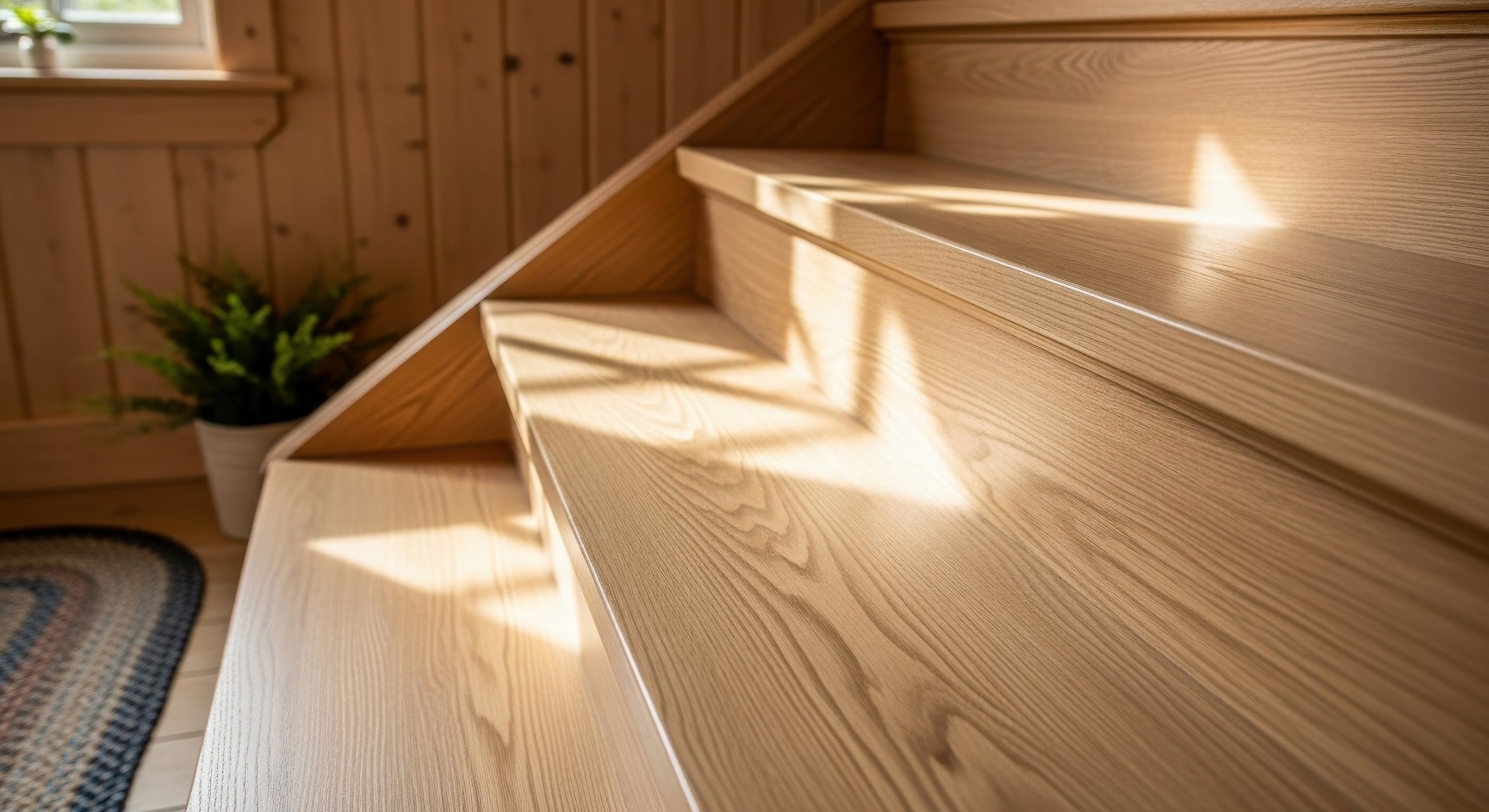
This question comes up constantly at Crestwood, MO , usually from someone who has just chosen a floor and assumed the stairs would be the straightforward part. Matching is very achievable. The path to a close match, though, depends almost entirely on whether your floor is solid or engineered and whether it is being finished on site or arriving prefinished.
Why A Stair Tread Is Not The Same Product As A Floor Plank
A floor plank is relatively narrow and comes as part of a run of boards laid side by side. A stair tread is a single wide piece carrying the full depth of the step, usually thicker than flooring and often built up from several staves glued together rather than cut from one board. They are different products made for different jobs.
That construction difference affects appearance even when the species is identical. Wider pieces show broader, more open grain than narrow strips do, and wood of different widths and cuts takes stain at slightly different rates. Two pieces of the same oak, one milled as flooring and one milled as a tread, will rarely read as perfect twins even under the same stain from the same can.
Why Engineered Flooring Changes The Answer
If your floor is engineered hardwood, using the same material on the stairs is usually not an option. The real wood veneer on top is thin, and a stair nosing takes concentrated wear right at the edge where that veneer is most exposed. Treads also need to carry structural load in a way that a thinner profile plank was never designed for.
Most engineered flooring manufacturers address this by offering coordinating stair treads and nosings built to match their flooring lines. These are made for the application and designed to sit alongside the floor visually. Availability varies by product and collection, so it is worth confirming that matching treads exist for the line you are considering before you commit to the flooring itself.
Site Finishing Produces The Closest Match
The tightest match comes from sanding and finishing the floor and the stairs at the same time. Raw treads go in, everything is sanded together, and the same stain from the same batch goes onto both surfaces under the same conditions on the same day.
That approach removes most of the variables that cause mismatches in the first place. Stain behaves differently at different temperatures and humidity levels, and batches can vary slightly from one to the next, so applying everything together is the most reliable way to get stairs and floor reading as one continuous surface rather than two separate decisions made weeks apart.
Matching To A Floor That Is Already Prefinished
When the floor is prefinished and already down, the match becomes an approximation rather than a guarantee. The strongest option is ordering the manufacturer's own matching treads for that specific product, since the factory finish and the color were developed alongside each other and tested as a pair.
Where that is not available, solid treads can be custom stained to match a sample of the existing floor. This usually gets close on color but is harder to match on sheen and surface texture, because factory applied finishes are cured in conditions that are difficult to replicate on site. Seeing a stained sample next to your actual floor, under your actual lighting, is the only reliable way to judge the result before committing to it.
The Parts People Forget To Decide
Treads are only part of a staircase. Risers, the vertical faces between the steps, are often painted rather than stained, which is a perfectly legitimate design choice and frequently the simpler one to execute well. Skirt boards running along the wall and the nosing profile at the front edge of each tread both affect how finished the whole staircase looks once it is done.
The nosing profile in particular is worth a proper conversation, since it shapes both the visual line of the stairs and how that leading edge wears over the years. These details tend to get decided late in a project, once the flooring choice is already locked in, and settling them earlier almost always produces a better looking result.
If you are planning stairs alongside a new or existing floor anywhere in St. Louis, MO, University City, MO, Richmond Heights, MO, Jennings, MO, East St. Louis, IL, Just Around the Corner Flooring can show you what a realistic match actually looks like before you order anything. Visit us at Crestwood, MO or contact us to compare samples in person, and browse our full hardwood flooring selection to see the options for both the floor and the staircase.


